
Where Food Abundance Meets the Red Dress: Remembering, Honouring, and Rebuilding Community

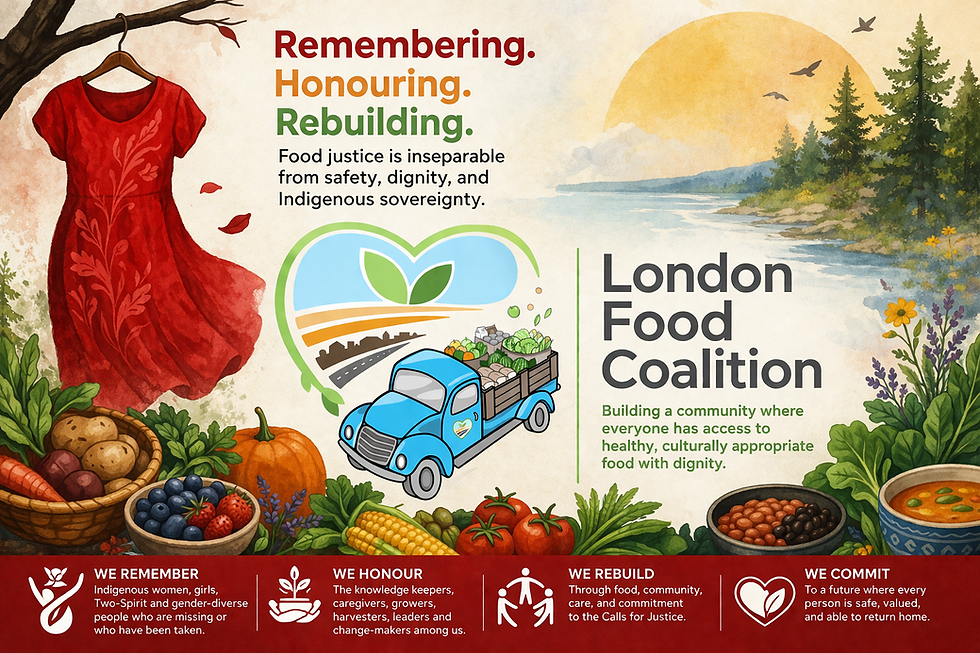
On May 5, red dresses appear in windows, trees, public spaces, gathering places and hearts across the country. They move in the wind like spirits asking not to be forgotten. They are beautiful, devastating and impossible to ignore. Red Dress Day, also known as the National Day of Awareness for Missing and Murdered Indigenous Women, Girls, Two-Spirit and gender-diverse people, is not only a day of remembrance. It is a day that asks Canada to look honestly at what has been taken, who has been taken, and what systems have allowed that violence to continue.
For the London Food Coalition, this day asks us to think deeply about food, land, community and care. Not as separate issues, but as connected responsibilities.
Long before food was measured in pounds, routed through warehouses, tracked in spreadsheets or distributed through agencies, food was relationship. Food came through land, water, seed, weather, patience, ceremony and the knowledge of those who knew how to listen. Across Indigenous Nations, women, aunties, grandmothers, girls, Two-Spirit people and gender-diverse community members have carried vital roles as caregivers, growers, harvesters, seed keepers, medicine gatherers, cooks, teachers, organizers and protectors. They have held families together. They have fed children. They have fed Elders. They have fed ceremony. They have fed resistance. They have fed the future.
From seed to harvest, from harvest to table, from table to community, Indigenous women have carried food systems not simply as labour, but as love. They have known what could be planted, what should be shared, what must be saved, what could heal, and what belonged to the next generation. Food abundance, in its truest form, is not only about having enough. It is about belonging to one another enough that no one is left unfed, unseen or unprotected.
That is why Red Dress Day belongs in conversations about food abundance.
Because when Indigenous women, girls, Two-Spirit and gender-diverse people are taken from their families and communities, the loss is not only individual. It is generational. A mother is missing from the kitchen, the garden, the school pick-up, the family table. A grandmother is missing from the stories, the recipes, the songs, the medicines, the teachings. A sister is missing from the laughter, the organizing, the care work, the future she was building. A Two-Spirit relative is missing from the circle, from the balance, from the wisdom and belonging their community needed. A girl is missing from the life she should have been allowed to grow into.
The National Inquiry into Missing and Murdered Indigenous Women and Girls named this violence clearly. It found that the crisis of MMIWG2S+ is rooted in colonialism, racism, sexism, homophobia, transphobia, poverty, displacement, child welfare systems, policing failures, health inequities and the ongoing destruction of Indigenous family and community life. It concluded that the violence experienced by Indigenous women, girls and 2SLGBTQQIA people amounts to genocide, not as a metaphor, but as a finding grounded in testimony, evidence and truth-gathering.
That matters because Red Dress Day cannot be reduced to awareness alone. Awareness is only the doorway. The National Inquiry gave Canada Calls for Justice, not suggestions, not symbolic gestures, not things to consider when convenient. They are legal imperatives, moral obligations and community responsibilities. They call for safety. They call for justice. They call for access to housing, health care, transportation, education, culture, language, child and family supports, and the conditions required for Indigenous women, girls, Two-Spirit and gender-diverse people to live full lives with dignity.
For a food coalition, that truth lands close to home.
Food systems are never neutral. Who has access to food, who grows it, who prepares it, who is trusted with it, who profits from it, who is denied it, and who is forced to line up for it all reflect deeper systems of power. When colonial systems removed Indigenous Peoples from land, disrupted traditional foodways, attacked language and ceremony, forced children into residential schools, and fractured families through child welfare systems, they also attacked food sovereignty. They attacked the ability of communities to feed themselves according to their own knowledge, values and relationships.
And still, Indigenous women kept feeding people.
They fed children with what they had. They stretched meals. They planted gardens. They gathered medicines. They organized community feasts. They made sure Elders had plates. They taught young people what could be eaten, what could heal, what must be respected and what must never be wasted. They carried knowledge through scarcity. They created abundance even when systems created hunger.
At the London Food Coalition, we often speak about food abundance as a different way of seeing the world. We reject the idea that communities are defined only by lack. We know there is enough food, enough care, enough possibility, if systems are built around fairness, coordination and dignity. But on Red Dress Day, we also have to say this: there is no true abundance when Indigenous women, girls, Two-Spirit and gender-diverse people are unsafe. There is no true community when families are still searching. There is no true justice when the people who have always fed, cared for and protected others are not themselves protected.
The empty red dress reminds us of absence. But it also reminds us of responsibility.
It asks us who is missing from our tables. It asks whose knowledge has been ignored in the building of our food systems. It asks whose labour has been taken for granted. It asks whether our understanding of food includes land, ceremony, kinship and justice, or whether we have made food into another system that moves resources while forgetting relationships.
For LFC, the answer must be relationship.
That means continuing to build food-sharing systems rooted in dignity, reciprocity and community leadership. It means understanding that food abundance is not only about pounds collected or meals served, as important as those measures are. It is also about the kind of community we are becoming. Are we listening? Are we making room? Are we honouring the people who have always known that food is sacred? Are we willing to understand that hunger, violence, poverty and colonialism are connected? Are we willing to see that the Calls for Justice are not separate from the work of food, health, housing, safety and belonging?
On Red Dress Day, we honour the Indigenous women, girls, Two-Spirit and gender-diverse people who should still be here. We honour the families who have carried grief while also carrying advocacy, memory and love. We honour the aunties, mothers, grandmothers, sisters, daughters, cousins, friends, seed keepers, harvesters, cooks, caregivers, land defenders and life-givers whose presence continues to shape communities, whether they are with us physically or held in spirit.
We also honour those who are here, doing the work every day. Indigenous women and gender-diverse leaders continue to feed communities, protect land, teach children, care for Elders, organize mutual aid, defend water, restore language, grow food, build ceremony and call systems to account. They are not symbols. They are not statistics. They are not only victims of violence. They are leaders, knowledge keepers, relatives and builders of abundance.
A red dress hanging in the wind is a grief. It is also a teaching.
It tells us that absence has a shape. It tells us that justice must be lived, not posted. It tells us that community is not whole until every person is valued, protected and able to return home. It tells us that food abundance must begin long before the table, in the soil, in the seed, in the safety of women and girls, in the protection of Two-Spirit and gender-diverse people, in the restoration of Indigenous leadership, and in the courage to answer the Calls for Justice with action.
From seed to harvest, from harvest to table, from table to community, we remember.
And in that remembering, we recommit ourselves to a future where no one is missing from the circle.


Comments